Alignment-induced depression and shear thinning in granular matter of nonspherical particles
Rheology of elongated particles in a linear split-bottom shear cell (DEM, MercuryDPM)
Key insight
Particle shape simultaneously controls surface morphology and bulk rheology in granular shear flow:
- Spheres (AR = 1) → dilatancy inside the shear band → flat surface
- Elongated particles (AR > 1) → alignment-driven compaction → surface depression
The same alignment mechanism also governs rheology:
- Increased alignment → higher packing density
- Modified contact network → shear-thinning behavior
This shows that microstructure (alignment) directly links morphology and flow resistance.
System (visual)
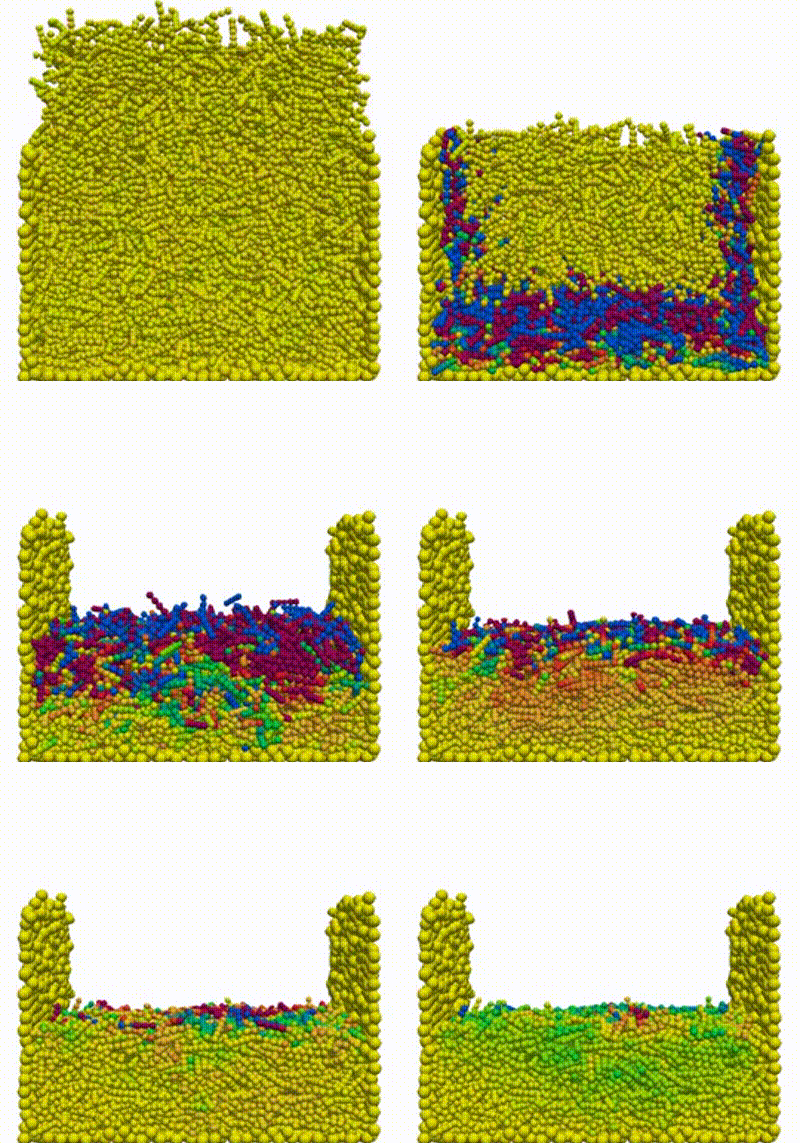
Linear split-bottom shear cell with elongated particles (DEM simulation).
See full simulations →
This work is published in Physical Review Fluids (2024).
DOI
What I did
- Simulated granular shear flow for aspect ratios AR = 1–5
- Quantified particle alignment and its localization inside the shear band
- Computed packing density fields to distinguish dilatancy vs compaction regimes
- Performed rheological analysis using stress tensor, normal stress differences, and inertial number scaling
Methods & tools
- Simulation: MercuryDPM, Hertz–Mindlin viscoelastic contact model
- Geometry: linear split-bottom shear cell (LSC), periodic in flow direction
- Driving: two L-shaped walls moving at ±Vx/2 (Vx = 0.038 m/s)
- Particles: multisphere elongated grains (overlapping and non-overlapping), AR = 1–5
- Parameter range: AR = 1–5 (including fractional AR for overlapping particles)
- Post-processing: coarse-grained continuum fields Q(y, z), averaged in x and steady state
Key results
1. Alignment localizes inside the shear band
- Strong alignment develops within the shear band
- For AR = 5: orientation decreases from 0.27π → 0.15π (~44% reduction)
2. Shape controls dilatancy vs compaction
- Spheres (AR = 1) → dilatancy → lower density in shear band → flat surface
- Elongated particles (AR = 5) → alignment-driven compaction → higher density → surface depression
3. Shape increases macroscopic friction
- Macroscopic friction increases with aspect ratio
- Saturation occurs at larger AR
- Overlapping particles show higher friction due to enhanced contact interactions
4. Shear-thinning emerges across all aspect ratios
- Effective viscosity decreases with inertial number → shear-thinning behavior
- At fixed inertial number: viscosity increases with AR
- Rescaling by macroscopic friction collapses data into two regimes:
- slope ≈ −1 → solid-like behavior
- slope ≈ −2 → fluid-like behavior
- slope ≈ −1 → solid-like behavior
Takeaway
Particle alignment is the key mechanism linking structure, surface morphology, and rheology in granular flow.
This work shows how microstructural evolution controls both compaction and shear-thinning behavior in dense granular systems.
Media
Publication
H. Rahim, V. Angelidakis, T. Pöschel, and S. Roy
Alignment-induced depression and shear thinning in granular matter of nonspherical particles
Physical Review Fluids (2024)
DOI · Preprint