Shear-Induced Pressure Anisotropy in Granular Flows of Nonspherical Particles
DEM study in a linear split-bottom shear cell (MercuryDPM)
Key insight
Particle shape fundamentally changes how stress is distributed in granular flow:
- Spherical particles (AR = 1) → nearly uniform and isotropic pressure field
- Elongated particles (AR = 5) → localized pressure increase inside the shear band
This pressure buildup is driven by:
- Shear-induced alignment → particles orient with flow
- Packing density increase → reduced void space
- Normal stress anisotropy → σyy, σzz > σxx
The result is a localized pressure peak — a granular analogue of normal-stress-driven effects.
System (visual)
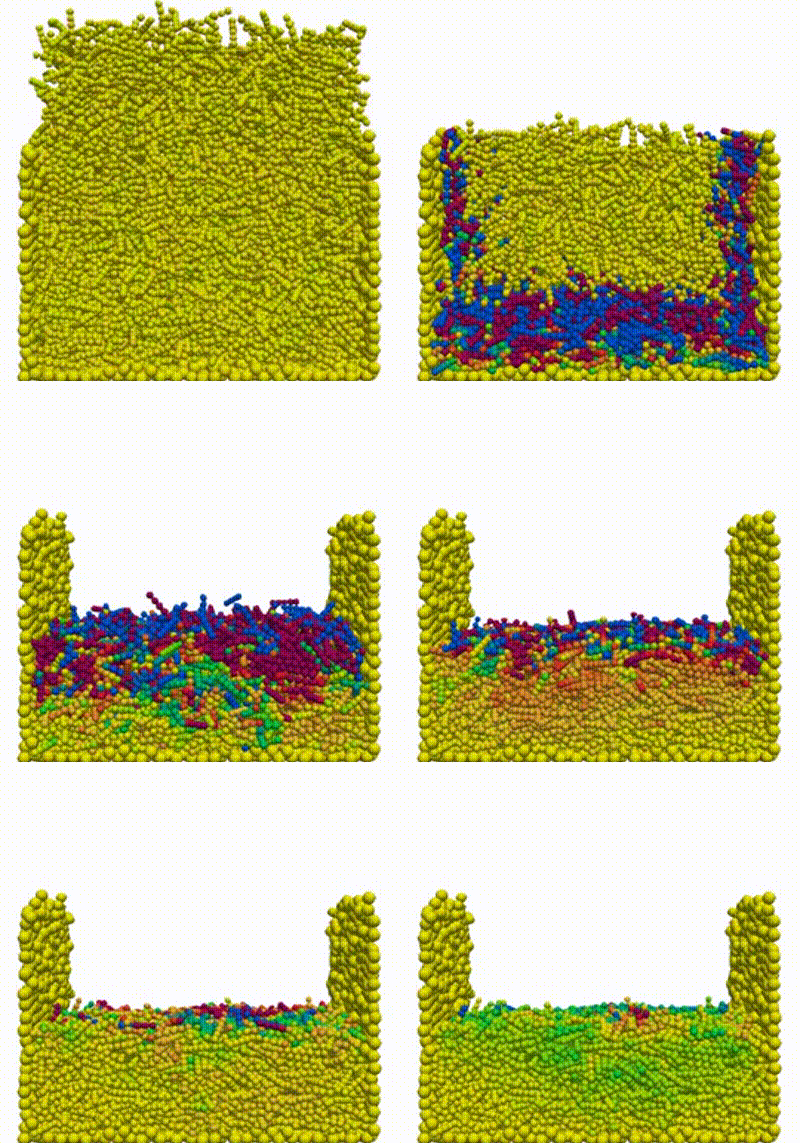
Linear split-bottom shear cell with nonspherical particles (DEM simulation).
See full simulations →
This work is available as a preprint and is under review at Physical Review E.
arXiv
What I did
- Performed DEM simulations comparing spheres (AR = 1) and elongated particles (AR = 5)
- Computed coarse-grained pressure and stress tensor fields in the y–z plane
- Quantified the relationship between alignment, packing density, and stress anisotropy
- Systematically varied friction (µ = 0.01–0.8) to study shear-band localization
Methods & tools
- Simulation: MercuryDPM (DEM), Hertz–Mindlin viscoelastic contact model
- Geometry: linear split-bottom shear cell (LSC), periodic in flow direction
- Driving: two L-shaped walls moving at ±V₀/2 (V₀ = 0.038 m/s)
- Particles:
- spheres (AR = 1)
- elongated multisphere particles (AR = 5)
- spheres (AR = 1)
- System size: (Lx, Ly, Lz) = (25, 25, 20) dp, N ≈ 4500, ±20% polydispersity
- Parameter range: friction coefficient µ = 0.01–0.8
- Post-processing: coarse-graining via
MercuryCG, averaged in x and steady state
Key results
1. Elongated particles generate a pressure peak
- Pressure becomes higher inside the shear band than in the bulk
- The pressure field localizes around the split region (y = 0)
2. Spheres remain nearly isotropic
- Pressure stays uniform across the domain
- Stress components remain close to isotropic
3. Mechanism: alignment → compaction → stress anisotropy
- Particles align with the shear direction
- Alignment reduces void space → higher packing density
- Increased contact forces produce σyy, σzz > σxx
- This leads to a localized pressure increase
4. Friction controls localization
- Low friction (µ ≈ 0.01) → wide shear band, weak pressure variation
- High friction (µ ≈ 0.8) → narrow shear band, strong pressure localization
Takeaway
Particle shape does not only affect structure —
it fundamentally changes how stress is transmitted in granular flow.
This work shows how alignment-driven packing and stress anisotropy generate localized pressure fields under shear.
Media
- ▶️ Simulation video: Watch on the Videos page
Publication
H. Rahim, S. Roy, and T. Pöschel
Shear-induced pressure anisotropy in granular materials of nonspherical particles
Under review, Physical Review E
arXiv