Impact of friction and grain shape on the morphology of sheared granular media
DEM simulations in a linear split-bottom shear cell (MercuryDPM)
Key insight
Sheared granular materials behave fundamentally differently depending on particle shape:
- Spherical particles → no surface deformation
- Elongated particles → develop a pronounced surface depression
This transition is governed by a competition between:
- Alignment-driven compaction (dominant at low friction)
- Friction-driven dilatancy (dominant at high friction)
Using DEM simulations, I show how these microscopic mechanisms directly control shear-band structure and free-surface morphology.
System (visual)
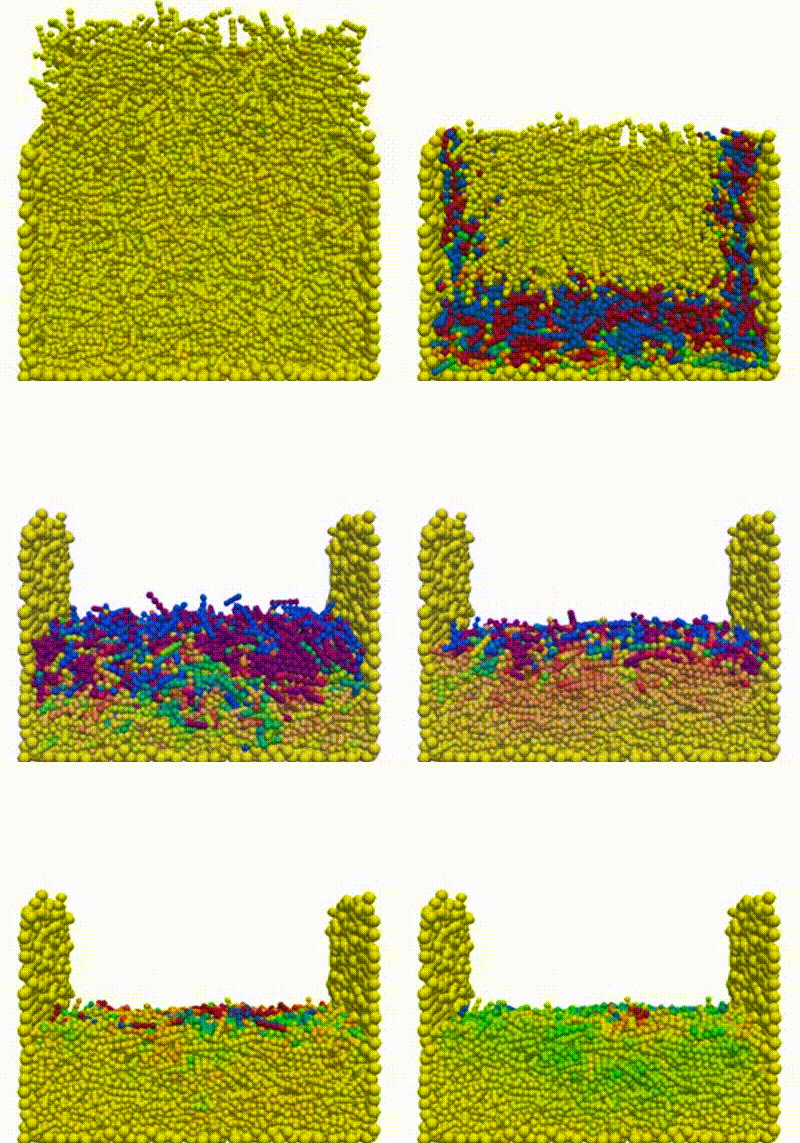
Linear split-bottom shear cell with elongated particles (DEM simulation).
See full simulations →
This work is published in Physical Review Fluids (2026), DOI.
What I did
- Built DEM simulations of spheres and elongated particles (AR = 1–5) in a linear split-bottom shear cell
- Computed continuum fields (density, velocity, stress tensor) using coarse-graining
- Quantified particle alignment inside the shear band using orientation statistics and nematic order parameter S
- Systematically varied friction (µ = 0.01–0.8) to isolate its effect on alignment, stress, and surface morphology
Methods & tools
- Simulation: MercuryDPM (multisphere particles, Hertz–Mindlin contact model).
- Geometry: linear split-bottom shear cell with periodic boundary conditions in the flow direction.
- Particles: spheres (AR = 1) and stick-shaped grains built from connected spheres (AR = 2–5).
- Parameter range: friction coefficient µ = 0.01–0.8; aspect ratio AR = 1–5.
- Post-processing: coarse-graining via
MercuryCG, analysis and plotting in Python / MATLAB.
Key results
1. Shape controls surface morphology
- Spheres (AR = 1) → flat surface
- Elongated particles (AR > 1) → clear surface depression
This shows that particle geometry alone can fundamentally change macroscopic behavior.
2. Friction weakens alignment
- Strong alignment at low friction → S ≈ 0.8
- Reduced alignment at high friction → S ≈ 0.4
Higher friction disrupts particle ordering inside the shear band.
3. Competing mechanisms inside the shear band
Two mechanisms control the system:
Alignment → compaction (density increases)
Dilatancy → expansion (density decreases)
Low friction → alignment dominates → broader depression
High friction → dilatancy dominates → localized deformation
4. Key physical insight
Surface morphology is not random — it directly emerges from:
- particle shape
- friction
- shear-induced alignment
This links microscopic particle physics → macroscopic flow behavior.
Takeaway
Particle shape and friction do not just modify granular flow —
they fundamentally determine how shear is localized and how the free surface evolves.
This work shows how microscopic alignment mechanisms translate into macroscopic morphology.
Media
Publication
H. Rahim, S. Roy, and T. Pöschel
Impact of friction and grain shape on the morphology of sheared granular media
Physical Review Fluids (2026)
DOI · Preprint